Sunday, March 18, 2012

Auto GPS buyers guide

Last updated November 17, 2009

Quite often, I am asked to recommend a GPS receiver. The answer typically is, it depends — primarily upon the price you can pay and the features you want. So here is an auto GPS buyers guide that runs the gamut, identifying some key features along the way. I'€™ll make a recommendation in each price category, based upon value, feature set and user reviews.

A few notes first:

  • I'll admit a bias towards Garmin. They manufacturer quality units with intuitive interfaces. Many of the models listed below are Garmin nuvis. You may find this Garmin nuvi feature comparison chart useful.
  • All the receivers listed below have a color touch screen interface and give voice-prompted turn-by-turn directions.
  • These lists of features worth paying extra for and features you don't need may prove helpful.
  • Prices on GPS receivers are dropping rapidly. The prices listed below are current as of the last update of this post. Keep an eye on our companion GPS Deals site for some great values.
  • Finally, unless otherwise indicated, the links go to auto GPS reviews here at GPS Tracklog, where you'€™ll find several places to track down each model'€™s current low price from trusted vendors.

Budget auto GPS receiversNuvi200left
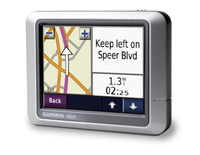
Our choice:

The Garmin nuvi 200 has maps of the entire U.S., except for Alaska. Like all the nuvis, the 200 has around 6 million points of interest (POIs).

The nuvi 200's retail price is $399.99, but as of this posting it can be found for around $130. Prices are quite variable though, and it’s worth looking at other low end models, such as the ones below. As I’m writing this, the nuvi 250 is available for around $125.

Alternative recommendations:

NOTE: The three budget units listed above have all been discontinued, but will remain fully supported by Garmin. They are great units and I’m very comfortable continuing to recommend them to folks looking for a deal.
read more

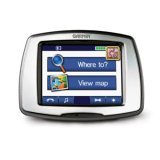
Garmin StreetPilot c550 review


UPDATE: Most of the several generations old StreetPilot series, including this model, has been discontinued. For a more current recommendation, check out our Auto GPS buyers guide or go straight to our Garmin nuvi comparison chart.


The Garmin StreetPilot c550 GPS is the first c-series StreetPilot to incorporate Bluetooth for hands-free cellphone use. An integrated traffic receiver also distinguishes it from other c-series units. A 3-month subscription is included in the U.S. — after that it will cost you $60 for 15 months. European users get a free lifetime subscription.
read more

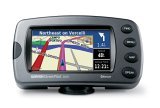
Garmin StreetPilot 2820 review

UPDATE: This model has been discontinued. For current recommendations, please refer to our auto GPS buyers guide.

Hot on the heels of the announcement of the newest StreetPilot, comes a full Garmin 2820 review from a motorcyclist’s perspective:

"The easiest way to describe this GPSR would be to say that it is the most competent motorcycle navigator I have ever used.

It is the same form factor as the previous 2xxx series Garmin GPSRs, which means it fits right into the Garmin Motorcycle Bracket, and uses the same power cable and other accessories as all the other 2xxx GPSRs. There are two slight differences with the accessories – the remote control is the newer version (same as the 27xx series), and the 12 volt adapter with the built-in speaker – the one you would use in a car, not on a moto – is also the same newer one with the more sophisticated speaker that was first introduced with the 27xx series. The 27xx and 28xx both feature true ‘text to speech’ – meaning, they pronounce the full street names – and that requires a higher fidelity speaker. The older remote from the 25xx series will work with the newer 27xx and 28xx products, but it doesn’t give you all the control that the new remote does.

The big improvement: A fully integrated Bluetooth system. You can pair your cell phone up to it, and also pair a Bluetooth headset (for example, a BMW System V helmet with the WCS 1 Bluetooth system – see the write-up about it here: BMW System V Helmet with WCS-1 Bluetooth Communication System), and voila, you have directional guidance in your helmet, radar camera audible warning in your helmet, phone audio in your helmet, and full control of your phone, including your phone directory, caller ID, even a reminder of phone battery life remaining on the screen of the GPSR.

If you get bored with all that, you can listen to music using the built in MP3 player, although the quality of the music is not the greatest when you are listening to it via the BMW helmet system. But… the 2820 comes with an audio in connector (and a tiny little clip-on microphone, for use in a car) and an audio out connector. I connected the audio out from 2820 to the 12 channel, 270 watt sound system in my Volkswagen Phaeton, and I was pretty happy with the music quality. Installing a 12 channel sound system in a helmet might take a bit of work, though…

Pairing up phones and headsets with the GPSR is very simple. You put the external device into ‘discoverable’ mode, then tell the GPSR to start looking. Once you have paired a device up, the GPSR automatically recognizes it and hooks up to it every time you go riding in the future – no further actions, button pressing, or attention is needed – it’s that simple. I could talk on the phone via my helmet in a parking lot, as long as I stayed within about 25 feet of the motorcycle. However – this is thoughtful – there is a touchscreen control that allows you to transfer the call from your helmet (or other headset) back to your phone, just in case you get off the moto and want to keep talking as you walk into the office, your home, a restaurant, etc.

Satellite acquisition is very fast, and the GPSR appears to keep a lock on the satellite constellation much better than previous models did. I have done about 1,800 kilometers of riding in the past week – Zurich to Dresden to Wolfsburg and back – and I never saw the ‘Lost Satellite Reception’ message, except for when I was in tunnels."

Compare prices on the Garmin StreetPilot 2820

read more

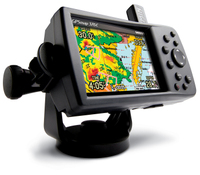
Garmin GPSMAP 376C review

Garmin_376c

UPDATE: This model has been discontinued. Check out our list of more current marine GPS receivers for alternatives.

The Garmin GPSMAP 376C marine and vehicle chartplotter updates the 276C, adding XM satellite radio and weather capabilities. Though listed as a marine unit, this is actually a dual-purpose device that supports City Navigator maps and turn-by-turn routing.

The 376C comes with base maps; if you want detailed maps, you’ll have to buy those separately. Garmin is currently updating the 376C with the GPSMAP 378 and 478, which have preloaded land and sea maps, and are expected to become available in late May 2006.

Here’s what others have to say about the Garmin 376C:

read more

Garmin GPSMAP 76CSx review

Garmin_76csx

UPDATE: The GPSMAP 76CSx has been discontinued. For current recommendations, check out our handheld GPS buyers guide or our Garmin handheld GPS comparison chart.

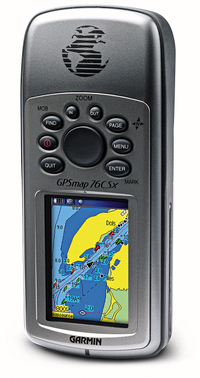
The Garmin GPSMAP 76CSx updates the Garmin GPSMAP 76CS with two major improvements. First, the 76CSx includes the  SiRFSTAR III chipset, which has been getting rave reviews for its fast acquisition time and awesome coverage under canopy, in urban canyons and even indoors!

UPDATE: In early 2009, it appears that Garmin stopped using the SiRFstar III chipet due to a patent dispute, substituting a MediaTek (MTK) chipset. While both are high-sensitivity chipsets, Garmin is still fine-tuning the MTK firmware. The switch to this chipset has reduced one of the advantages the 60/76 C(S)x series has enjoyed over newer Garmin models.

UPDATE 2: Here’s my 2010 take on SiRFstar III and the newer chipsets.
read more

GPS for your car: Factory-installed or aftermarket unit?

GPS navigation systems for cars are becoming quite popular, and there are some basic questions that  prospective buyers are asking. One is, should I buy a factory-installed GPS, or an add-on (also known as aftermarket or OEM) unit? Let’s look at the arguments for and against each approach:

Factory installed GPS

Pros

  • A better appearance, as units are built into the dash or located on the instrument panel.
  • Theft is generally not an issue (unless they take the whole car!).

Cons

  • The cost is typically considerably more than an aftermarket unit.
  • Getting updated maps may be difficult and expensive.
  • Fewer options are available.
  • Units cannot be moved from one vehicle to another.

read more

Alphabet soup – AIO’s, CE and GPS

In case you’ve been seeing it in reference to GPS receivers and are wondering, AIO stands for all in one. In my last waypoints collection of shorts, I mentioned a new Pioneer GPS receiver that runs Windows CE. Now you may be wondering why you would want Windows CE on your GPS.  Today, GpsPasSion fills in the details:

While they have yet to break through in the US, WinCE based AIOs are selling like hot cakes in Europe, likely because they do the job and have the added bonus of letting you install many different applications once they’ve been "customized".

They go on to discuss some other interesting hacks:

Forum member PsiDOC has posted guides on how to (legally) install GPS favorites, TomTom and OziCE on a Packard Bell GPS400 or other AIOs.

I should add that the GpsPasSion post title mentions customizing Magellan and Mio receivers too.

Technorati tags: GPS

Magellan eXplorist 400 review

Explorist400

UPDATE: The Magellan eXplorist line has been officially discontinued. For an overview of our current recommendations, check out our handheld GPS buyers guide.

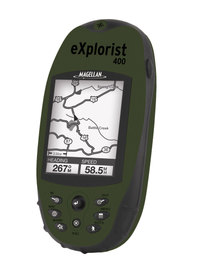
The Magellan eXplorist 400 is one of eight different eXplorist models (16 if you differentiate between the North American and European editions).

So what distinguishes the 400 from adjacent models in the series? Lower units like the eXplorist 300 don’t have SD slots like the 400 does, so you are limited to the memory onboard in lower models. The eXplorist 500 is identical to the 400, except that the 500 adds a color screen with improved resolution.

Compare prices on the Magellan eXplorist 400

Here’s what others are saying about the eXplorist 400:


Here are some additional resources that may prove useful:

Compare prices on the Magellan eXplorist 400 at these merchants:

Why have an electronic compass?

Electronic_compass

NOTE: A much more current version of this post can be found here.

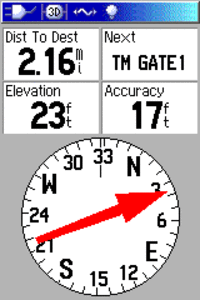
A GPS receiver discerns your position on the surface of the earth by measuring the length of time it takes to receive signals from satellites. It cannot, however, tell what direction you are facing while standing still (or moving slowly). So if you are navigating to a waypoint, a basic GPS can only point you in the correct direction once you are moving.

This is where an electronic compass comes in handy. It can tell what direction you are facing, even while standing still. Not only does this make navigating easier, it also helps with projecting waypoints and orienting paper maps. Units with an electronic compass usually have a barometric altimeter as well.

Some of the latest models even have a tri-axial compass, meaning you don’t even have to hold it level.

read more

Garmin Vista Cx Review

Vista_cx_2

UPDATE: This model has been discontinued. For more current recommendations, please refer to our handheld GPS buyers guide or our Garmin handheld GPS comparison chart.

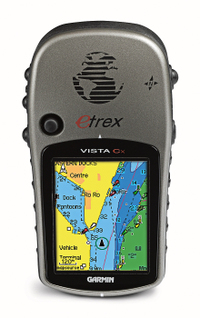
The Garmin eTrex Vista Cx updates the very popular eTrex Vista C, adding expandable memory via a micro-SD card, which will provide plenty of room for optional highway and/or topo maps. This is a nice compact unit, ideal for use in the great outdoors and for navigating city streets.


read more