Sunday, March 18, 2012

Garmin auto / marine units – GPSMAP 378 and 478

Gpsmap_478
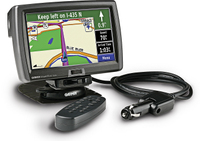
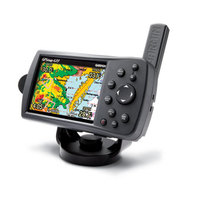
No, these aren’t GPS receivers for your amphibious vehicle. But if you’ve got a pickup truck and a boat trailer, they could be the units for you. Earlier today, Garmin announced the GPSMAP 378 and GPSMAP 478 (pictured at left).

These new receivers have pre-loaded marine AND highway maps for North America. Both units come with a marine mount and automotive kit, so you can use them to drive to the dock and then pop them into your boat. The GPSMAP 378 has 10-meter resolution charts for 3200 inland lakes, while the GPSMAP 478 has charts for the entire U.S. coastline, including Alaska and Hawaii.

Both units come pre-loaded with City Navigator ® NT for highway navigation, and optional XM radio weather capabilities.  They are expected to be available  in late May 2006 with an expected street price of $1199.99.



Technorati tags: GPS, marine

SiRFstarIII – Why it’s a big deal

Sirf_logo
UPDATE: Here’s my 2010 take on SiRFstar III, which is rarely available these days.

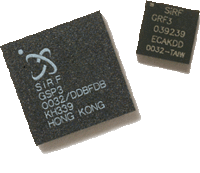
There are a lot of hot new GPS receivers that use the SiRFstar III chipset, but unless you’re a heavy-duty GPS aficionado, you may be wondering, what the heck is this thing and what is the big deal? Simply put, it is a GPS receiver chipset. This is the little piece of silicon responsible for receiving GPS signals and passing the coordinate information along to a miniature computer in your GPS unit.

Why is it a big deal? Fast acquisition times and processing power. This translates into less likelihood of lost signals under canopy and in urban (or natural) canyons. In canyon-like environments, your GPS receives signals directly from satellites whenever it can, but it also receives reflected signals, bouncing off hard surfaces (multipath reflection). Your GPS determines yourSirfstar_iii
position by calculating how long it takes the satellite signal to reach your receiver, so reflected signals are a source of error. The SiRFstar III chipset has the processing power to do a lot of "what if’s" with these reflected signals. This processing power also means that the chipset can consider weak signals that were ignored by previous chipsets. The SiRFstar III also has faster acquisition times, making for a faster time to first fix (TTFF), and a quicker reacquisition if the signal is lost.

All of this translates into amazing reception, under canopy, in urban centers and even indoors. And that is why the new Garmin units with this chipset are so hot.

read more

Can my GPS be used to track me?

This has got to be one of the most frequently asked questions about GPS. The short, simple answer is no, your GPS cannot be used to track you. That is because most GPS devices are receivers; they transmit nothing. There are rare exceptions, such as the Garmin Rino series, designed to transmit your location to a friend.

Having said that, there is a more complex answer. First of all, if you have the tracklog enabled on your GPS receiver, someone with access to your GPS can physically connect it to a computer, download the track and see where you’ve been and when. Of course, that is all very different than real-time tracking. Just don’t use a GPS to guide you to a bank heist!

Many companies do make real-time GPS tracking devices, which have transmitting capabilities built into them. These can be used to track everything from lost pets to teenagers to commercial vehicle fleets. We’re not talking about your typical GPS receiver here; these are specialized devices.

And then there are cell phones with A-GPS. Many cell phones have options allowing you set it to "location on" or "911 only." You would need to have it set to "location on" to utilize GPS-assisted location based services. The legal issues surrounding access to this information by law enforcement agencies have yet to be fully sorted out.

Then there are other places a GPS may lurk, many times unknown to a person driving a car with GPS. Got Onstar? You’ve got GPS. Ever rent a car? Better check the fine print in the contract.

A couple of other references:

  • Wikipedia entry for GPS tracking, which hypothesizes "The consumer electronics market was quick to offer remedies (radar detectors) to radar guns; a similar market may exist for devices to counter satellite tracking devices. Radio jamming of the relevant GPS or cell phone frequencies would be an option, as would a device which could detect the RF emissions of the GPS receiver circuitry."
  • An article from Pocket GPS World on privacy concerns and the future of GPS.

Technorati tags: GPS

Garmin StreetPilot 7500 Review

Streetpilot_7500 UPDATE: Most of the several generations old StreetPilot series, including this model, has been discontinued. For a more current recommendation, check out our Auto GPS buyers guide or go straight to our Garmin nuvi comparison chart.


The Garmin StreetPilot 7500 is identical to the StreetPilot 7200 with one added feature, described by Amazon this way — “As a step-up feature from the 7200, the 7500 includes dead reckoning sensors to track your vehicle’s course when the GPS signal is blocked, which can occur when driving in urban areas or tunnels. If you lose GPS coverage in areas with tall buildings or tunnels, the StreetPilot 7500 keeps on navigating. This feature requires professional installation.”

Like the 7200, the 7500 has a big seven-inch touch-screen, and was designed with RV’s, buses and semi-trucks in mind. And like it’s sister unit, it includes an audio book reader, an MP3 player and XM satellite radio. With XM radio, you not only get music, but also weather and real-time traffic conditions that overlay maps in major metropolitan areas in the U.S. The StreetPilot 7500 uses this data to automatically calculate and suggest faster alternate routes before traffic starts backing up. Of course this is all in addition to pre-loaded maps of North America, a touch screen interface and voice-prompted routing.

Compare prices on the Garmin StreetPilot 7500

read more

Garmin Quest 2 Review

Quest_2

UPDATE: This model has been discontinued. For current recommendations, please refer to our auto GPS buyers guide.

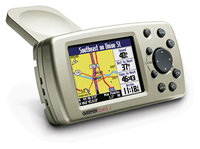
The Garmin Quest 2 is an updated version of the original Quest GPS receiver. The Quest 2’s internal memory comes pre-programmed with either the North American or European version of City Select NT. This is a significant improvement over the original unit, which would hold only 115 MB of maps, and had to be transferred from CD.

Four readers at Amazon gave an average 3-1/2 out of 5 star rating in their Garmin Quest 2 reviews.

Some additional info on the Quest 2:

read more

Garmin Forerunner 205 Review

Forerunner_205_1

UPDATE: This model has been discontinued. For information on current models, check out our GPS for runners page.

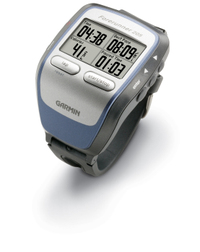
The Garmin Forerunner 205 is a stylish update of the Forerunner 201. But don’t judge it just by looks. The 205 has the new SiRFSTAR III chipset that has been garnering rave reviews for its amazing performance under canopy, in urban canyons, and even indoors!

The primary difference between this unit and the Forerunner 305, is that the 305 has a heart-rate monitor; the 205 does not.

Compare prices on the Forerunner 205

Here’s what others are saying about the Forerunner 205:

read more

Garmin eTrex Legend Cx Review

UPDATE: This model has been discontinued. For more current recommendations, please refer to our handheld GPS buyers guide or our Garmin handheld GPS comparison chart.

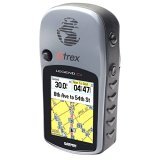
The Garmin eTrex Legend Cx updates the popular Legend C model by adding a micro-SD card slot for expandable memory (hence the “x”). This is a great upgrade, since the Legend C’s 24 MB of internal memory was almost too small to effectively utilize City Select software for highway use.

read more

nuvi 310, nuvi 360 introduced by Garmin

Nuvi_310UPDATE: Check out our Garmin nuvi
360 review
.

Earlier today, Garmin unveiled the nüvi 310™ and nüvi 360™, two new additions to this popular product line. The nüvi™ is described by Garmin as an all-in-one Personal Travel Assistant™.

Both units feature Bluetooth "wireless technology with a microphone and speaker that lets you make hands-free mobile phone calls. Simply dial numbers with the nüvi’s touch screen keypad to make a call on a compatible Bluetooth phone. To answer calls, just tap nüvi’s screen and speak directly into its built in microphone." Both units also feature anti-theft technology; "Garmin Lock™ disables the nüvi from performing any functions until the user types in a specific 4-digit PIN or takes the unit to a predetermined secure location code. If the user does not know the PIN or secure location, the nüvi will be inoperative." Finally, the new nüvi’s have an SD slot that can accommodate options like Language Guides, a Travel Guide for Europe (U.S. coming soon) or a Savers Guide. Both units are expected to be available in June 2006.

Garmin nüvi™ 310

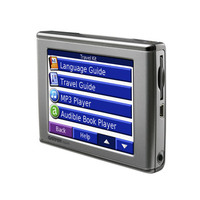
The Garmin nüvi™ 310 (pictured at left above), is the successor to the nüvi™ 300 and is available only in Europe. It comes pre-loaded with City Navigator® NT Europe data for one of the nine regions. Of course, like the 300, the 310 comes with MP3 player, audio book player, JPEG picture viewer, travel alarm, and currency converters. An optional FM traffic receiver provides Nuvi_360real-time traffic information.

Garmin nüvi™ 360

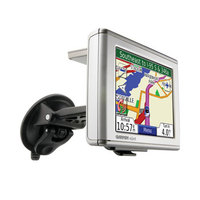
The Garmin nüvi™ 360, pictured at right, updates the incredibly popular nüvi™ 350. Pre-loaded with City Navigator® NT North America or Europe (full coverage), the other main difference between this and the 310 is that the 360 features turn-by-turn voice-prompted directions that speak street names.

Technorati tags: GPS

Garmin GPSMap 60Cx Review

Gpsmap_60cx
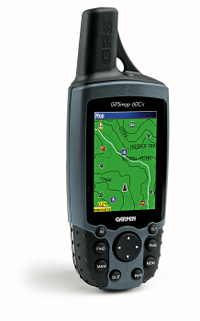
The Garmin GPSMap 60Cx is an updated version of the GPSMap 60C. This new unit comes with the SiRFSTAR III chipset, which has been getting rave reviews for its fast acquisition time and solid coverage under canopy, in urban canyons and even indoors!

UPDATE: In early 2009, it appears that Garmin stopped using the SiRFstar III chipet due to a patent dispute, substituting a MediaTek (MTK) chipset. While both are high-sensitivity chipsets, Garmin is still fine-tuning the MTK firmware. The switch to this chipset has reduced one of the advantages the 60/76 C(S)x series has enjoyed over newer Garmin models.

UPDATE 2: Here’s my 2010 take on SiRFstar III and the newer chipsets.

UPDATE 3: This model has been superseded by the Garmin GPSMAP 62.

UPDATE 4: This model has been discontinued. For more current recommendations, please refer to our handheld GPS buyers guide or our Garmin handheld GPS comparison chart.

The other significant upgrade is that the 60Cx no longer utilizes the unit’s built in memory for MapSource maps, but loads them to a microSD card instead (the unit comes with a 64 MB card). This means you have unlimited map storage capability, plus you can use some of the newer MapSource software that is available only on SD cards. Stepping up to the 60CSx adds a barometric altimeter and electronic compass. To see how the 60Cx stands up against other Garmin models, check out my Garmin handheld GPS comparison chart.

read more

Garmin GPSMap 76Cx Review

Gpsmap_76cx_1

UPDATE: The GPSMAP 76Cx has been discontinued. We recommend the GPSMAP 78s as an alternative.

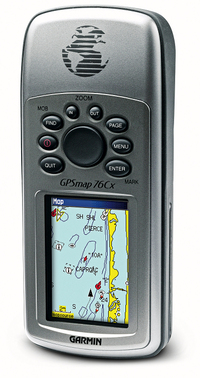
The Garmin GPSMap 76Cx is an update of the popular Garmin GPSMap 76C, which has been well loved by mariners and landlubbers alike. The 76Cx has the new SiRFSTARIII chipset, which has been garnering accolades for its fast acquisition time and awesome coverage under canopy, in urban canyons and even indoors! The other significant upgrade is that the 76Cx no longer utilizes the built in memory for MapSource maps, but loads them to a microSD card slot instead (the unit comes with a 128 MB card). This means you have unlimited map storage capability, plus you can use some of the newer MapSource software like City Select Mexico. Stepping up to the 76CSx adds a barometric altimeter and electronic compass. To see how the 76Cx stands up against other Garmin models, check out my Garmin handheld GPS comparison chart.

Compare prices on the Garmin GPSMAP 76Cx

UPDATE: In early 2009, it appears that Garmin stopped using the SiRFstar III chipet due to a patent dispute, substituting a MediaTek (MTK) chipset. While both are high-sensitivity chipsets, Garmin is still fine-tuning the MTK firmware. The switch to this chipset has reduced one of the advantages the 60/76 C(S)x series has enjoyed over newer Garmin models.

UPDATE 2: Here’s my 2010 take on SiRFstar III and the newer chipsets.
read more